A pizza crust is a short story told in three acts: fermentation, stretch, and heat. Miss any one of them and the ending does not land. The reason a pizza from a chain tastes like a pizza from a chain — and not like the one you had in Naples in 2014 — is almost never the toppings. It is the crust. And the crust is almost always a function of how hot the oven runs and how long the dough was allowed to sit before it got there.
Start with fermentation. Commercial pizza dough, the kind delivered frozen to most kitchens, is usually mixed, rolled, and par-baked within a few hours. That is enough time to pass for bread. It is not enough time for a pizza. Our dough is mixed on one day and baked on the next — a minimum of 24 hours of cold fermentation, often longer. During those hours the wild and commercial yeasts work through the dough's complex sugars, producing carbon dioxide (which gives you lift) and a long list of flavor compounds (which give you the slightly tangy, slightly nutty base note you cannot fake).
Hydration matters too. Most chain dough runs around 55–58% hydration — meaning the water weighs 55–58% of what the flour weighs. That produces a dense, bready, forgiving dough that any line cook can handle. Our dough runs much wetter, closer to 65%. Wetter dough is harder to work with but it gives you a more open crumb, a crispier shell, and a lighter chew. When you pull a slice from a well-made high-hydration pizza, it folds without cracking, and when you bite it the crust shatters on the outside and stays pliant on the inside. That is the hydration talking.
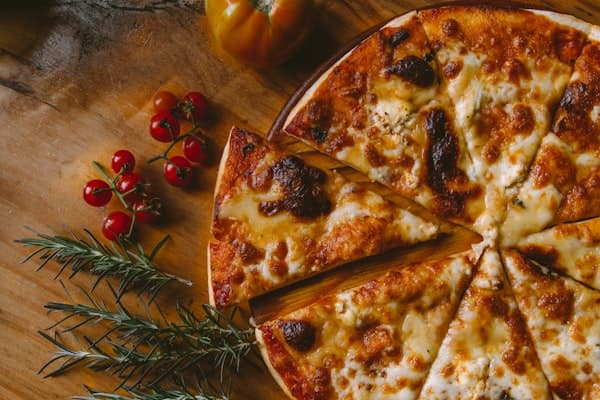
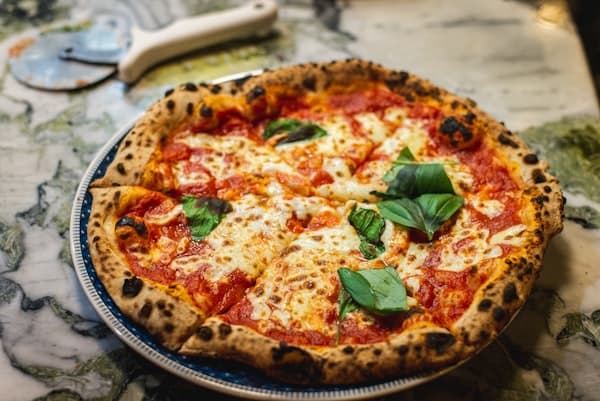
Now the heat. This is the part most people underestimate. A home oven, wide open, hits about 550°F. A restaurant deck oven runs 600–700°F. A proper coal oven — the kind Frank Pepe's is running — sits between 700°F and 900°F, with spots on the floor that climb higher. We bake closer to the top of that range than the bottom. Why does it matter? Because at those temperatures the Maillard reaction, the browning chemistry that gives you caramel, toast, and the char on a steak, fires up in a different league. Proteins and sugars on the crust surface get to full brown in 60 to 90 seconds — before the interior of the dough has had a chance to dry out. That is why a real New Haven pie has leopard spotting (those black char bubbles) on the underside and the top cornicione while the center is still soft and airy. In a slow, cool oven you either overbake the inside chasing the char or you never get the char at all.
A few practical consequences come out of this. The first is that we cannot preheat. The oven is already where it needs to be, all day, every day. The second is that a pie does not hold well in a bag. The combination of high moisture at the center and crisp char at the edge is perishable; it survives a short ride home, not a long one. That is part of why we run as a walk-in shop. The third is that no two pies are exactly alike. Dough hydration shifts with the weather. The oven has a hot side and a cooler one. One pie lands a little darker on the left; the next one lands a little darker on the right. Pizza is a craft before it is a product.
If you are ordering from us for the first time, try your first pie on-site if you can. Watch the crust. Hold a slice by the far edge and notice whether it droops or stands rigid — you want a gentle droop, not a flop and not a plank. Look underneath. You are looking for brown, not blonde, with dark spots. That is the 800°F doing its job. If the crust passes those tests, everything else — the sauce, the cheese, the toppings — is a matter of taste. The crust is a matter of chemistry.