New Haven-style pizza — locals call it "apizza," pronounced ah-BEETZ — did not start on a menu board. It started in a basement on Wooster Street in 1925, when a Neapolitan immigrant named Frank Pepe began firing pies in a coal-burning brick oven. The neighborhood was Italian. The oven was old-world. The formula was simple: thin, stretched dough, crushed plum tomatoes, a dusting of grated cheese, and the kind of char you only get when an oven runs at 700–800 degrees for decades at a time.
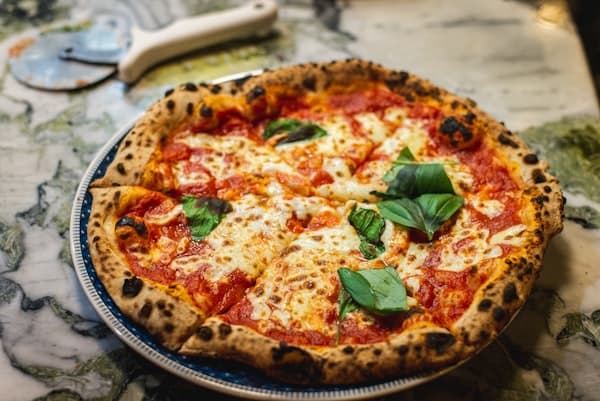
What made Pepe's style different from the Neapolitan tradition he grew up with was the crust. Instead of the soft, wet center of a classic Napoletana, coal-oven apizza developed a drier, crispier base — almost cracker-like at the edge, still pliable at the center, with black "leopard spots" that locals treat as proof of authenticity. That crust is the single thing every New Haven pizza maker is measured against. Too pale, and you did not trust the oven. Too burnt, and you did not respect the dough.
In 1938, one of Pepe's nephews, Salvatore "Sally" Consiglio, opened Sally's Apizza two doors down. The rivalry — Pepe's vs. Sally's — became the defining debate of New Haven eating. Ask five locals and you will get five answers, but almost nobody argues that either place lost its way. Both are still open. Both still run coal ovens. Both still sell out on a Friday night with a line that does not care about the weather.
The signature order at either spot is the white clam pie: fresh little-neck clams shucked to order, olive oil, garlic, oregano, pecorino — no mozzarella, no red sauce, nothing to hide behind. It sounds strange until you have one. Then it makes sense. The briny shellfish against the charred crust is the clearest statement of what apizza is trying to be: ingredient-forward, regional, unapologetic.
There is a structural quirk worth knowing. A New Haven pie is not round. The dough is hand-stretched, usually into an oblong, and the char pattern follows the drag of the peel across the oven floor. Cheese, when it is there, is usually sliced provolone or mozzarella with shredded mozzarella on top. Tomato is always crushed, never cooked down into a sweet sauce. Oregano is the dominant herb. Olive oil goes on at the end.
The style has traveled. It took nearly eighty years for New Haven-style pizza to show up in serious form outside of Connecticut, but in the last decade a small wave of makers has carried the tradition out — to New Jersey, to the Hudson Valley, to Philadelphia, and now to the 19382. At Pizza West Chester we do not run a coal oven; our deck oven hits the same temperatures with a different fuel, but the goal is the same: char on the bottom, a blistered top, crushed tomato that tastes like a tomato, cheese that melts without drowning the crust.
We do not think we are reinventing anything. We think there is a right way to make a pizza and that the New Haven tradition figured out most of it a hundred years ago. Our job is to stretch a dough that has had enough time to develop, to crush a tomato that tastes like the season it came from, and to pull the pie out of the oven at the second the crust earns its char — not before, not after. That is the history. That is also the recipe.